


Easter Sunday is one of the greatest feasts of Christianity, as on this day we celebrate the Resurrection of Christ. See how it is celebrated in every corner of Greece.
HDN Newsroom
Easter in Greece is called "Pascha" that in Hebrew means: passage, passage. It is a Jewish holiday in memory of the Exodus of the Jews from Egypt, the miraculous crossing of the Red Sea under Moses and their salvation from the slavery of Pharaoh. For Christians, it means redemption from sin and the passage from death to life.
Christ was sacrificed on the day of the Jewish Passover, which that year fell on the Sabbath, and was resurrected after the Sabbath, "the first day of the week," that is, the first day of the week, which for this reason was called Sunday.
The "first Resurrection" of the Lord takes place shortly after midnight on Holy Saturday, when the priest exclaims "Christ is Risen". Shortly before, the Holy Light has also been distributed so that the faithful can spread the joyful news of the Resurrection of the God-Man.
On Easter Sunday or Love Sunday, in the Mosque of Aigio in the village square, the custom of the burning of Judas is performed. The custom is revived by the Cultural Association of the Mosque of Aigio. On the evening of Easter Sunday, in the square, in front of the church of Agios Georgios, a theatrical event takes place that represents the trial of Judas, at the end of which the effigy is thrown into the fire.
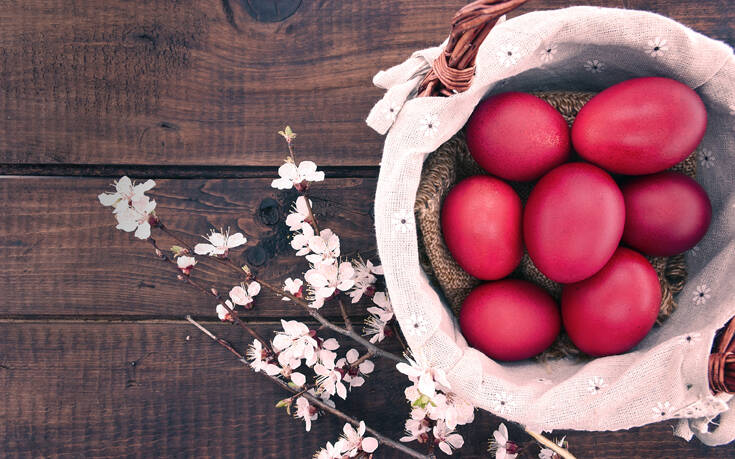
Greek Easter customs in every corner of Greece
Easter in Arachova: The procession of the icon of St. George
An important custom in Arachova is the procession of the icon of Saint George. On Easter Day, locals dressed in traditional costumes walk around the icon of the Saint, while the next day the struggle of the elders takes place. Old men start a race on an uphill road, from the church of Agios Georgios, to the hill. Behind them follow dance groups that accompany them, while other tests and competitions called "kleftika" follow, such as the lifting of the stone.
Easter Sunday in Kalamata: The Saitopolos
One of the most well-known customs of Easter Sunday is the Saitopolos in Kalamata. Specifically, on Easter Day, at 8:00 p.m., the "saitologists" gather in the city center, in the northern parking lot of Nedontas and in Othonos Square. There, the "saitologists" will throw their arrows, in a spectacular and unique spectacle, which captivates the locals and the many visitors who come from Kalamata to spend the Easter holidays.
Epirus: The "Dead" Zafiris"
The custom of the "Dead Sapphire" is revived in Epirus, on Easter Sunday. "Dead Zafiris" is essentially a child's game. The role of the "dead" is played by a small child, and around the rest, they decorate him with various flowers and leaves and at the same time mourn him, holding reeds instead of candles in their hands. At the end, the children shout loudly "Get up Zafiris, get up" and the little child who was decorated with flowers and leaves gets up and chases the other children, in order to catch someone so that he can make "Zafiris" the next year.
Easter in Kythnos: The custom of the "Swing"
In Kythnos, they have the custom of "swing". According to this, on Easter Sunday in the central square of the village, a swing is set up in which boys and girls alternately swing dressed in traditional costumes. According to the custom, any boy who shakes a girl and vice versa, commits himself before God and men to marriage.
Easter Sunday: Judas is shot on
Shortly after midnight on Holy Saturday and the "Christ is Risen", in Panagiouda of Lesvos, several people gather with their weapons and shoot a log with the effigy of Judas hanging on it. The shots completely destroy the torso, throwing the "defeated Judas" to the ground.

Easter in Chios: The rocket "war" in Vrontado
On Easter Sunday in Chios, the impressive rocket war takes place, which is one of the oldest customs of Holy Week and keeps its roots from the Turkish occupation.
The improvised rockets that are launched on Easter Sunday are made of sulfur, gunpowder and nitrous and their preparation begins the very next day, so that everything is ready for the next Easter.
The spectacle created by the thousands of rockets is spectacular and captivates locals and foreigners alike who come to the island to see up close the beautiful custom of rocket warfare in Chios.
Tyre Kynouria: Fireworks at the Port
On Easter Sunday, in the parish of the Transfiguration of the Savior, in the port of Tyre, one of the most impressive customs of Lambri takes place.
Specifically, the Tsakonian arsonists, accompanied by fireworks and dynamite, burn the effigy of Judas in the sea on a special raft. This custom has been going on since the time of the Ottoman occupation.
At the same time, on Lambri, in the parish of Agia Marina in the square, the priests of Tyre read the Gospel in Tsakonian dialect and then a feast follows in the central square with skewers of local wine and a folk orchestra. There you will also see the historical Tsakonian dance being danced.
Rethymno: The burning of the "orphan"
In every village of Rethymno, the custom of the "orphan" takes place on Easter Sunday. In essence, this custom is the burning of the effigy of Judas and the goal of each neighborhood is to reach as high as possible in relation to the others during the burning. For this custom, large quantities of wood are collected, so that the fire is as large as possible.
Easter in Tripoli: Vines and lambs
After the "Christ is Risen" and the evening service, the vines are lit almost immediately in all the barbecues in Tripoli, so that everything is ready for the spitting of the sheep on Sunday morning. Lambs, kokoretsia and traditional pies are the typical dishes enjoyed by those who celebrate Easter in Tripoli.
Easter in Zakynthos: Boiled meat on the Sunday table
The resurrection service in Zakynthos takes place at dawn on Sunday, a few hours after the end of Holy Saturday and not immediately.
On Easter Sunday, people gather at home to celebrate the Resurrection of the God-Man, while at home there is boiled meat (goat or beef) to balance the stomach from the fast of Holy Week, alongside the traditional pies.
Easter in Iraklia: Melitinia
In Iraklia on Easter Eve, housewives prepare magiritsa and melitinia, sweets made from fresh local goat mizithra.
In the afternoon they prepare the traditional stuffed goat with rice and liver, with the necessary spices, such as salt, oregano and pepper, which is simmered in the wood-fired oven until the end of the Resurrection service.
On Easter Day, the inhabitants gather in the courtyards of the houses, roast lambs and have fun with traditional songs and dancing and drinking, until dawn.
The Sunday table in Kalymnos: The "mouuri"
On Easter Sunday, the inhabitants of Kalymnos eat the so-called "mouuri". A "mouuri" is a stuffed lamb or goat, which each family keeps in its field or yard, which is placed in a large clay pot on vines. After being sealed in the clay pot, with porridge, flour and water, salt and pepper, the "mouuri" is simmered in a traditional oven with stone and wood from Holy Saturday, so that it is ready for the table of Lambri.
Easter in Astypalea: The big yellow pretzels
In Astypalea on Easter Sunday, residents eat large yellow buns, which are prepared in huge sheets. The buns, however, do not have a sweet taste, from egg yolks, but have a spicy taste due to saffron, while expensive herbs from saffron stamens, which have been collected since late autumn on the island.
But what makes the buns different is the dough that contains fresh, thick mizithra, which the locals get from the barns, almost before it has time to cool.
Easter Sunday in Rhodes: "Lambriatis"
On Easter Sunday in Rhodes, Lambri's table contains "Lambriatis" along with traditional pies of the island and the local wine. "Lambriatis" is a lamb or goat that has been baked for many hours in the oven and is filled with rice, garlic, raisins, pine nuts, onions, tomatoes, offal and the appropriate spices, such as oregano, salt and pepper. In the villages of Rhodes, the stuffed lamb or goat is also called "kappamas".
Easter Sunday in Koufonisia
On Easter Day, in the beautiful and special Koufonisia, the inhabitants taste goat stuffed with rice and spices in the oven, the traditional food of Lambri's day and do not roast lambs as is done in most areas of Greece.


