


Today, October 26, Thessaloniki celebrates with pomp, respect and every solemnity the anniversary of the liberation of the city from Ottoman rule and its Patron Saint, Agios Dimitrios.
Alina Loi
At 11:00 today, the doxology for the patron saint of the Great Martyr Agios Dimitrios Myrovlitis took place at the Church of Saint Demetriou, presided over by His Beatitude Archbishop of Athens and All Greece Mr. Ieronymos, in the presence of the President of the Republic Katerina Sakellaropoulou, with the participation of the State, Political, Military leadership and the Local Government Authorities.\

Tomorrow, at 11:00, at Tsimiski Street, the student parade will take place, starting from Diagonion and ending at I. Dragoumi where students of Primary, Middle and High Schools of the city will parade.
All eyes will be on the military parade, which will take place on Monday at 11:00 on M. Alexandrou Avenue. The earth will crackle from the armored tanks that will parade, from Papandreou Georgiou Street to the White Tower, while for yet another year the Rafale and the Air Force demonstration by the F-16 Individual Aircraft Demonstration Team "ZEUS" will steal the impressions. The message of the pilot, George Sotiriou, is expected to cause chills of emotion. The President of the Republic of Cyprus, Katerina Sakellaropoulou, will also be there.
The October 28 parade will be attended by 66 student and civilian sections, including the army, military police, mechanized infantry, tanks, artillery, engineer, communications and health departments. The Hellenic Air Force, Hellenic Police, Coast Guard – Hellenic Coast Guard and Fire Brigade will honor with their presence the parade of October 28th. The tankers Rhodes, Chios, Lesvos and the frigate Nikiforos Fokas sailed to Thessaloniki for the celebration of the National Day.
However, they honor the anniversaries and universities of Thessaloniki, as the official celebration of the day of the Patron Saint of Thessaloniki Saint Demetriou, the 112th anniversary of the liberation of the city and the epic of the '40s, will take place today at the Aristotle University of Thessaloniki. The ceremony will begin with the Apolytikion of Saint Demetriou by the "Yannis Mantakas" Choir of the Aristotle University of Thessaloniki, followed by the rector's address and the speech of the day's panegyric by the Professor of the Department of Philosophy and Pedagogy Filimon Paionides, entitled: "The epic of the '40s and the Theory of Just War".
The University of Macedonia organized an event on Friday, October 25, where the panegyric was delivered by Professor Christos Nikas, entitled: "The reconstruction of the Greek economy after the end of the war period 1940-49 and the Marshall Plan".
The measures of the Police are draconian. The Minister of National Defence Nikos Dendias, the Minister of Defence of Cyprus Vasilis Palmas, the President of PASOK-Movement for Change Nikos Androulakis, the President of the SYRIZA Parliamentary Group Nikos Pappas, as well as General and Honorary Consuls are also scheduled to be in Thessaloniki. In the city, apart from the local government and opposition MPs, Stefanos Kasselakis will also be present.
Traffic regulations in the central municipality are already in force on Wednesday, which will last until Monday. On Sunday, during the student parade that starts at 11:00, vehicles will not be allowed in Tsimiski, Pavlou Mela and all vertical streets. For Monday, from 3:00 until the end of the military parade that will start at 11:00, it is forbidden to stop and park all vehicles on Megalou Alexandrou Avenue and the surrounding streets.

The life of the Great Martyr Demetrios
On October 26, the Orthodox Church celebrates the memory of Saint Demetriou, patron saint of Thessaloniki. Saint Demetrius was born around 280-284 AD and died in 303 or 305 AD in Thessaloniki and is one of the Great Martyrs of Christianity. Dimitrios was the son of an aristocratic family in Thessaloniki. He soon rose through the ranks of the army, and at the age of 22 he held the rank of chiliarch. As an officer in the Roman army under the command of Tetrarch (and then emperor) Galerius Maximian, when Diocletian was emperor, he became a Christian and was imprisoned in Thessaloniki in 303 AD for ignoring Emperor Diocletian's decree "on the denial of Christianity". In fact, a little earlier he had founded a circle of young people to study the Bible.
In prison was also a young Christian named Nestor, who would face in a duel the terrible gladiator of the time Lyaeus. The young Christian before the duel visited Demetrius and asked for his help. Saint Demetrius gave him his blessing and the result was that Nestor defeated Lyaeus and provoked the wrath of the emperor. It was then ordered that both Nestor, Demetrius, be killed. The authors of the eulogies of Saint Demetriou, Efstathios of Thessaloniki, Gregory Palamas and Dimitrios Chrysoloras, report that the body of the Saint was buried in the place of martyrdom, and the tomb was transformed into a deep well gushing myrrh, hence the nickname of Myrovlitos. In Byzantine icons as well as in modern hagiography, Agios Dimitrios is depicted several times as a rider with a red horse (as opposed to the white horse of St. George) stepping on the infidel Lyaeus.
Why he is the patron saint of Thessaloniki
Today, October 26, Saint Demetrios is honored as the patron saint of Thessaloniki. With the help of Saint Demetriou, the city of Thessaloniki was saved many times from the raids of Avars, Slavs and Bulgarians. Its defenders often recounted seeing a warrior on his horse advancing in front of crowds and pursuing enemies with his sword. In this form it is also presented by the Byzantine hagiography. Indeed, on the feast day of the Saint, October 26, 1912, the Greek army entered Thessaloniki victoriously, liberating it from the Turks.
The liberation of Thessaloniki on October 26, 1912, during the First Balkan War, was a milestone in modern Greek history.
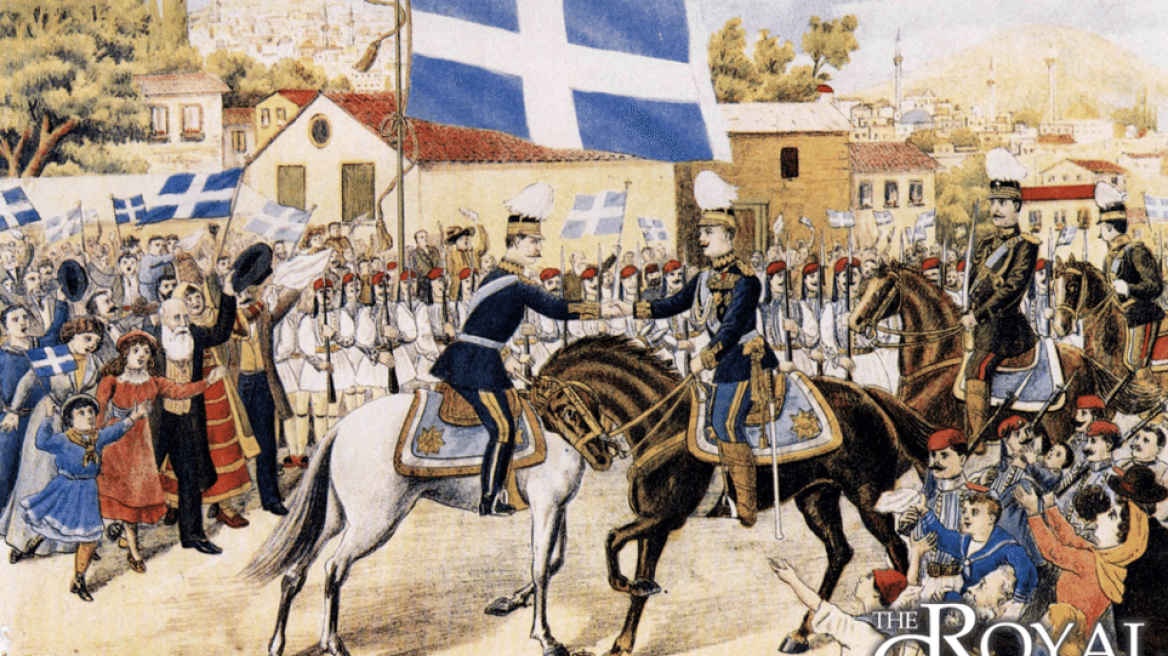
The liberation of Thessaloniki from the Turks
The city was under the control of the Ottoman Empire and was an important strategic hub for the Balkans. For Greece, the capture of Thessaloniki was vital, as it was the key to Macedonia's victory.
The Greek army, led by Crown Prince Constantine, advanced rapidly towards Thessaloniki after the victories at Sarantaporo and Giannitsa.
On October 25, Greek troops were on the outskirts of the city, while Bulgarian forces were approaching from the north. The Ottoman commander of Thessaloniki, Hassan Taksin Pasha, recognizing that he could not defend the city, agreed to surrender it unconditionally, signing a capitulation with the Greek army.
The treaty of surrender of the city was signed on the morning of October 26.


