


To speak of Kostis Palamas is to speak of the very soul of modern Greek identity. During an era when Greece was struggling to define itself between its glorious ancient heritage and a turbulent modern reality, Palamas emerged as a guiding light.
By:Christen Papas
Through his poetry, his fierce advocacy for the "Demotic" (the people’s) language, and his universal vision, he became much more than a writer; he became a national symbol.
Born in Patras in 1859, Palamas was no stranger to tragedy. By the age of seven, he had lost both parents, forcing him to move to Missolonghi to live with his uncle. This "Sacred City" of the Greek Revolution, with its haunting lagoons and heroic history, left an indelible mark on his spirit. It was here that his nostalgic and lyrical voice began to take shape, long before he moved to Athens to (briefly) study Law.

Palamas was the undisputed leader of the "New Athenian School" (the Generation of 1880). At the time, Greek literature was trapped in a rigid, archaic form of the language (Katharevousa) and a gloomy, fading Romanticism. Palamas and his peers staged a revolution. They demanded that poetry be written in the language people actually spoke—the Demotic.
His first collection, Songs of my Fatherland (1886), was a manifesto for this change. He proved that the common tongue was capable of expressing the highest intellectual and emotional truths.
The work of Palamas is vast, but several milestones define his greatness:
-
* The Tomb (1898): A heart-wrenching elegy written after the death of his young son, Alkis. It remains one of the most powerful depictions of paternal grief in world literature.
-
The Twelve Lays of the Gypsy (1907): A philosophical epic where the protagonist—a marginalized Gypsy—represents the free-thinking spirit that destroys the old to build the new.
-
The King's Flute (1910): A grand narrative set in the Byzantine era, aiming to bridge the gap between Ancient Greece and the modern world.
-
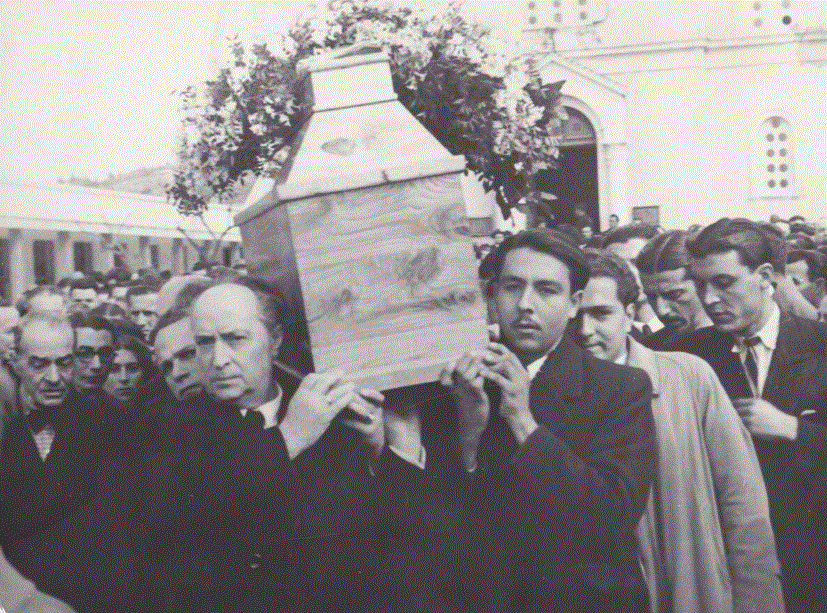
A Funeral as an Act of Resistance

Perhaps the most powerful moment in Palamas’ legacy occurred after his death on February 27, 1943. Greece was under Nazi occupation. His funeral at the First Cemetery of Athens turned into a massive, spontaneous protest. As the great poet Angelos Sikelianos recited a fiery poem over the coffin, thousands of Greeks defied the Axis soldiers, singing the National Anthem. Even in death, Palamas gave his people the courage to hope for freedom.
Frequently Asked Questions FAQs
1. Why is Kostis Palamas known as a "National Poet"?
While Dionysios Solomos is the primary national poet (author of the National Anthem), Palamas is considered the "second" national poet because he unified Greek history and culture through his work, spanning from Homeric times to the 20th century.
2. Did he write the Olympic Hymn?
Yes. Palamas wrote the lyrics for the Olympic Hymn, which was first performed at the 1896 Athens Games. It remains the official anthem of the International Olympic Committee (IOC) to this day.
3. What was his "day job"?
For 30 years, Palamas served as the Secretary of the University of Athens. He was a dedicated civil servant, balancing his administrative duties with his immense literary output.
4. Was he ever considered for the Nobel Prize?
Yes, remarkably, Palamas was nominated for the Nobel Prize in Literature 14 times. Although he never won, his frequent nominations highlighted his status as a giant of European letters.
5. What is his most famous poem for beginners?
"The Tomb" (O Tafos) is often the most accessible due to its raw emotion, while his "Olympic Hymn" is the most globally recognized.


