


1. The Heraklion Massacre (1898): The Bloody Turning Point for Cretan Freedom
One of the darkest yet most decisive chapters in modern Greek history was written in Heraklion, Crete, on August 25, 1898 [1.1]. Following Greece's defeat in the Greco-Turkish War of 1897, the Great Powers had imposed a status of semi-autonomy on the island. However, this temporary political solution fell short of the Christian Cretans' true aspiration: complete union (Enosis) with the Kingdom of Greece.
The catalyst for the tragedy occurred when British forces, who were responsible for maintaining order in the sector, attempted to install Christian clerks at the city’s customs office. This administrative decision infuriated the local Muslim population (Cretan Turks) and the Ottoman authorities. An enraged mob, operating with the blatant tolerance—if not the active encouragement—of the Ottoman garrison, launched a savage attack against the city's Christian inhabitants.
The outcome was horrifying: approximately 700 Greek Christians were brutally massacred, including Lysimachos Kalokairinos, the Vice-Consul of Great Britain. Seventeen British soldiers were also killed in the chaos, and the city was systematically looted and set ablaze.

However, this act of barbarism backfired spectacularly on the Ottoman Empire. The reaction from Great Britain and the other Great Powers was immediate and severe. Seventeen ringleaders of the massacre were publicly hanged, and the Ottoman army was forced to completely and permanently evacuate the island. This tragic event drastically accelerated the diplomatic process, leading directly to the declaration of the autonomous Cretan State under Prince George of Greece, which ultimately paved the way for Crete's official unification with Greece in 1913. Today, the most central and commercial avenue in Heraklion proudly bears the name "25th of August Street", serving as an eternal tribute to the victims of that fateful day.
2. The Liberation of Paris (1944): The End of the Nazi Nightmare
On the global stage, August 25, 1944, is forever linked to one of the most glorious and emotional moments of World War II: the Liberation of Paris [1.1]. After four long years of brutal Nazi occupation, the French capital finally breathed the air of freedom once again.
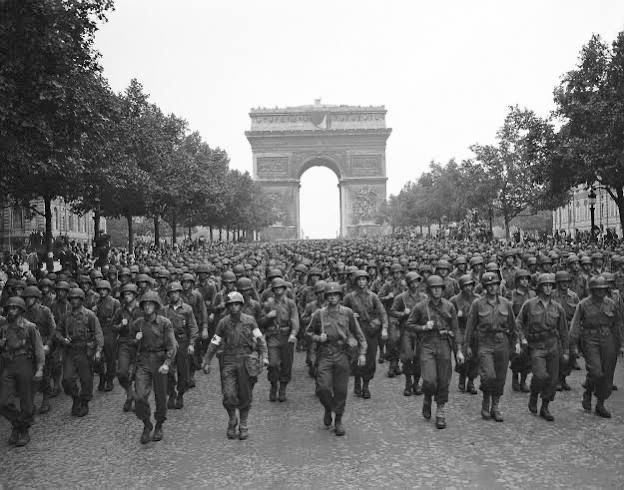
French soldiers march in triumph in front of the Arc de Triomphe, marking a glorious turning point in World War II.
The countdown to liberation had begun a few days earlier with a massive uprising by the French Resistance (FFI) inside the city. On August 25, the French 2nd Armored Division under General Philippe Leclerc, backed by US forces, triumphantly entered Paris. The German military governor, Dietrich von Choltitz, defiantly disobeyed Adolf Hitler's explicit, frenzied orders to reduce the city to a pile of rubble and blow up its historic landmarks—including the Eiffel Tower and the Louvre. Instead, von Choltitz chose to surrender to the Allies.
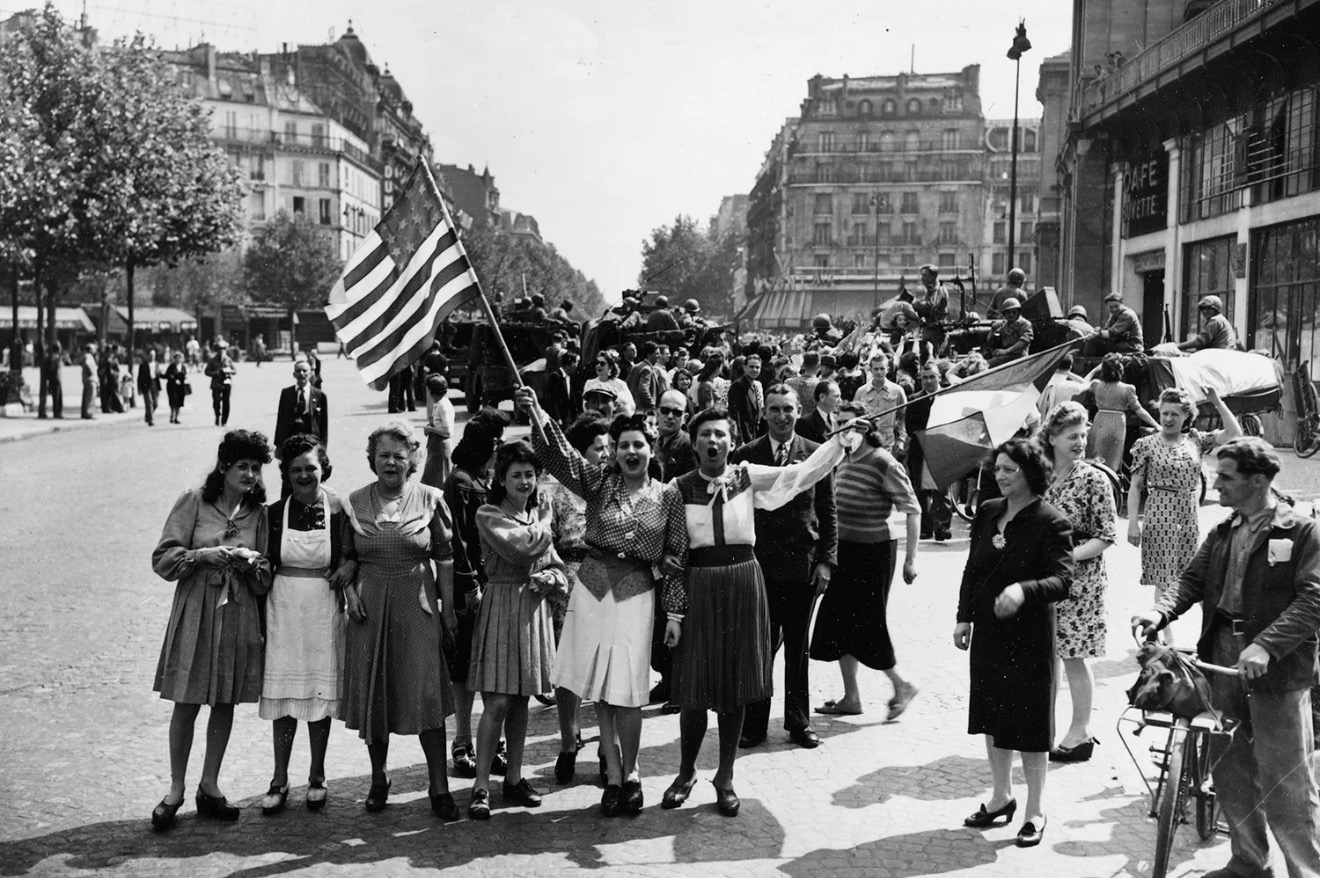
Parisians celebrate with French flags on the streets of the capital as four years of occupation come to an end, August 1944.
General Charles de Gaulle, leader of the Free French forces, delivered his legendary speech from the steps of the City Hall (Hôtel de Ville): "Paris outraged! Paris broken! Paris martyred! But now, Paris liberated!" The image of the French Tricolor waving proudly once again from the top of the Eiffel Tower became the ultimate global symbol of the impending collapse of the Third Reich.
3. Notable Births: The Icons Who Changed World Culture
Sean Connery (1930 – 2020)
Leonard Bernstein (1918 – 1990)
Tim Burton (1958)
4. Major Deaths: The Final Journey of Great Thinkers
Friedrich Nietzsche (1844 – 1900)
On August 25, 1900, the revolutionary German philosopher Friedrich Nietzsche drew his last breath in Weimar [1.2]. His death came after a decade of severe mental collapse and total isolation. Nietzsche, through his radical and provocative works—such as Thus Spoke Zarathustra and Beyond Good and Evil—fundamentally challenged the very foundations of Western morality, religion, and metaphysics. His complex concept of the "Übermensch" (Overman) and his famous declaration that "God is dead" profoundly influenced existentialism, psychology, postmodernism, and 20th-century literature, making him one of the most misunderstood yet deeply influential thinkers in human history.
James Watt (1736 – 1819)
5. Other Remarkable Milestones
-
1875 - Swimming the English Channel: Captain Matthew Webb secures his place in history by becoming the first person to successfully swim across the English Channel. He braved the treacherous waters from England to France, completing the historic feat in 21 hours and 45 minutes.
-
1928 - Football Kits Get Numbers: For the very first time in football history, players take the field wearing numbers on the back of their shirts during matches featuring Arsenal vs. Sheffield Wednesday and Chelsea vs. Swansea. The home teams wore numbers 1–11, while the away players wore 12–22.
-
1975 - The Launch of "Born to Run": Bruce Springsteen releases his iconic, career-defining album Born to Run. The record instantly catapults him into the global rock elite and remains universally celebrated as one of the greatest rock and roll albums ever recorded.
-
2004 - Fani Chalkia's Olympic Record: At the Athens Olympic Games, Greek hurdler Fani Chalkia electrifies the home crowd by breaking the Olympic record in the 400m hurdles during the semifinals with a stunning time of 52.77 seconds [1.4]. This historic run set the stage for her to capture the coveted Gold Medal.


